01
Use case
Choose a specific user outcome and distinguish essential behavior from optional features.
CAPABILITY 01 / AI PRODUCTS
From an interesting idea to software that has a clear purpose, an understandable architecture and a path for learning from actual use.
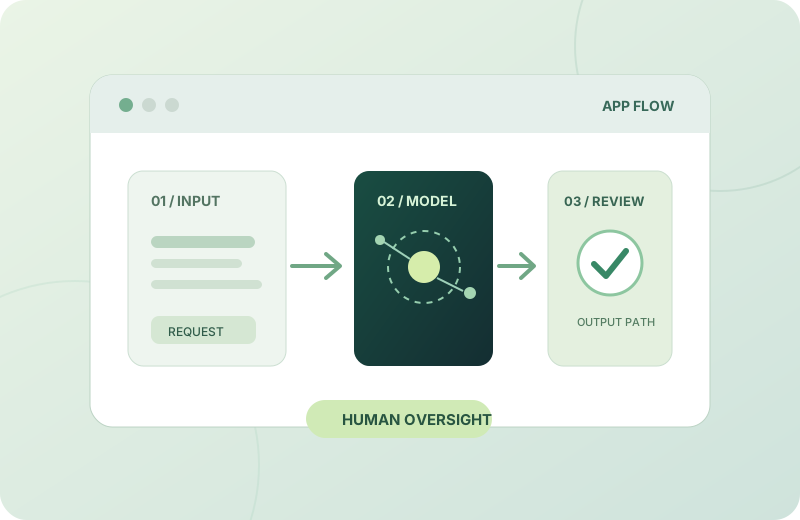
WHAT MATTERS
An AI product should begin with a job worth helping someone complete. We look at who uses the product, which steps require judgment, what data is appropriate and what success would actually mean.
The model is one component. The surrounding application—data handling, user experience, verification and fallback behavior—is often what determines whether the product is dependable.
Read: From AI prototype to product ↗DEVELOPMENT CONSIDERATIONS
Choose a specific user outcome and distinguish essential behavior from optional features.
Identify data contracts, API boundaries, model integration and error conditions.
Test representative and difficult cases, not just ideal example prompts.
Use observations to make bounded changes and keep earlier good behavior intact.
TECHNOLOGY WITH CONTEXT
Even small prototypes benefit from deliberate decisions about how inputs are validated, how outputs are presented and what happens when external services are unavailable.
A PRACTICAL PRODUCT LOOP
A deliberate product loop connects user needs with design, evaluation, and continuous learning.
COMMON QUESTIONS
No. The technology should earn its place through a concrete advantage. Conventional search, rules, databases or carefully designed interfaces may be the better answer for a given task.
A prototype demonstrates potential. A product must additionally account for real users, permissions, error handling, accessibility, operations, maintenance and relevant privacy and security needs.
By acknowledging that AI outputs can be wrong, designing suitable verification and human review paths, and testing representative use cases before expanding scope.
NEXT STEPS
See how automation and software quality complement AI application development.