Clear inputs and outputs
Define the shape, freshness and meaning of information moving between steps. Make missing data and invalid values explicit.
CAPABILITY 02 / CONNECTED WORKFLOWS
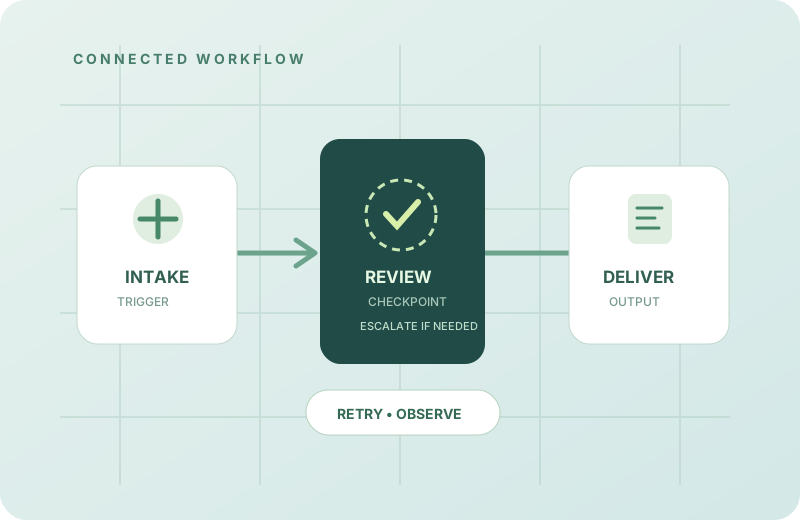
Automating a task is easy to describe. Designing a workflow that people can observe, maintain and recover when things go wrong takes more thought.
OUR PERSPECTIVE
The goal of workflow automation is not to remove people from every decision. It is to reduce repetitive effort while making important events, exceptions and responsibilities easier to understand.
In connected systems, small issues can accumulate: duplicate updates, expired credentials, partial failures or a changed upstream API. We are interested in approaches that make these conditions visible rather than hiding them behind a green dashboard.
Read our note on failure-safe automation ↗THE PRACTICAL BUILDING BLOCKS
Designing for the incomplete and unexpected cases is what makes automation useful beyond a one-off demo.
Define the shape, freshness and meaning of information moving between steps. Make missing data and invalid values explicit.
Consider idempotency, safe retries, timeouts and checkpoints before a failed run becomes a costly manual cleanup.
Record useful state, make exceptions reviewable and keep a clear owner for decisions that need judgment.
WORKFLOW DESIGN
Identify the trigger, people, tools, source data and real outcome. Look for repeated work and exceptions before automating anything.
Separate reversible steps from irreversible actions. Decide what the system can do automatically and what requires confirmation.
Prefer clear contracts between steps, recorded state transitions and integrations that can be diagnosed independently.
Design retry limits, escalation paths and observable checkpoints. A successful workflow is one that can also recover responsibly.
EXAMPLE AREAS OF EXPLORATION
These examples show where thoughtful automation patterns can improve everyday software workflows.
Test execution, documentation changes, issue handoffs and quality checkpoints.
Structured intake, routing, classification and traceable review of incoming material.
Monitoring, content preparation and controlled cross-tool coordination.
No. A process may first need simplification or clarification. Automating a confusing process can make its problems happen faster.
Some choices require judgment, accountability or context beyond the available data. A clear review step is often a strength, not a failure of automation.
You can explain what happened, why it happened and what to do if an expected result is missing or incorrect.
RELATED THINKING
Testing and traceable change make connected systems easier to maintain.